
Supercritical Drying – Aerogels
What…
is supercritical CO₂ Sterilisation?
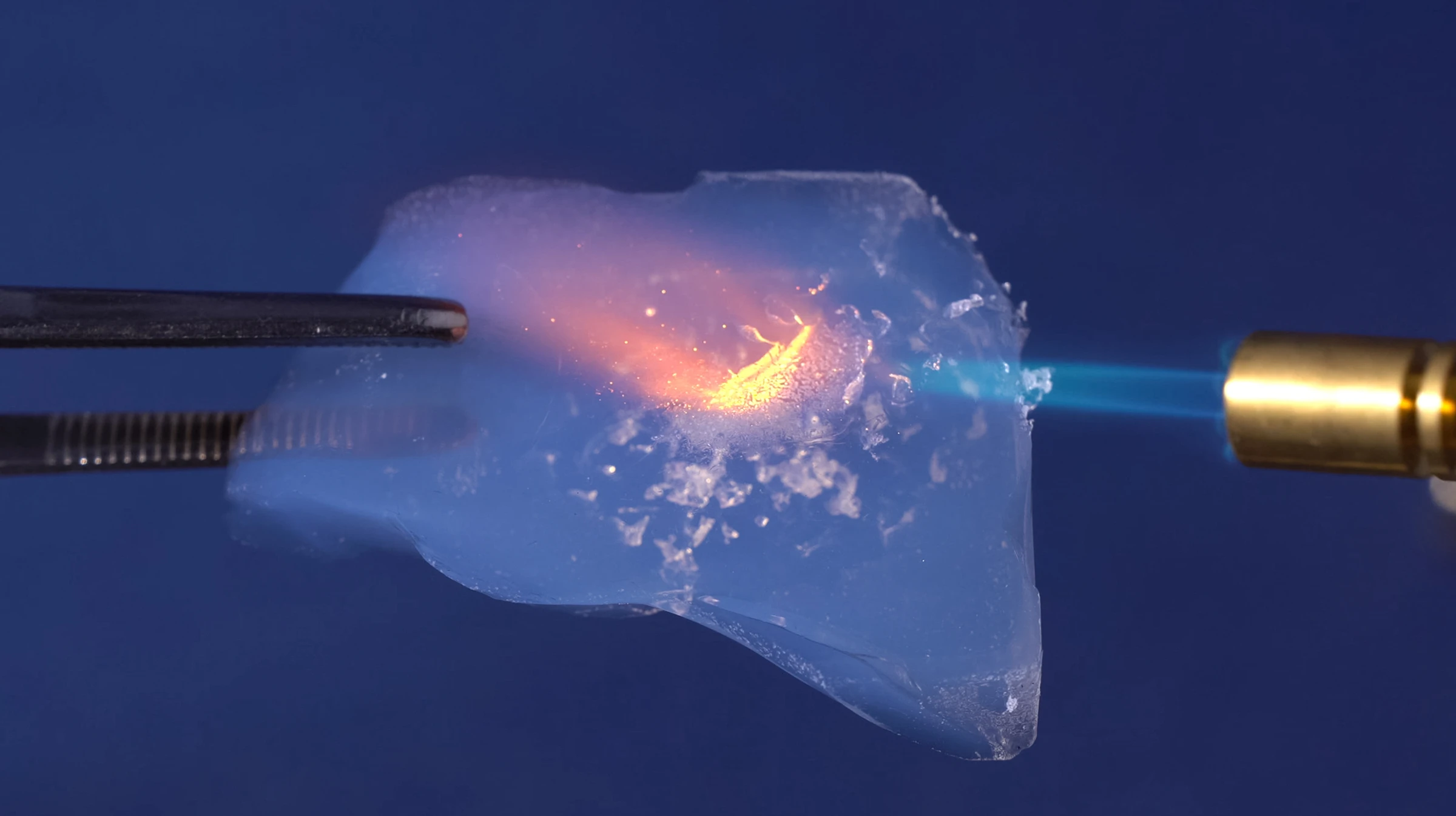
Supercritical CO₂ drying removes liquid from a gel without allowing the structure to collapse. The wet gel is first exchanged into a solvent compatible with CO₂, then brought above the critical point of CO₂ (31 °C and 74 bar). In this state, CO₂ behaves as a dense fluid with gas-like diffusivity and liquid-like solvating power, enabling it to dissolve and replace the pore liquid before being vented as a gas.
Why…
use supercritical CO₂ Sterilisation?
With supercritical CO₂ there is no liquid–vapour boundary, meaning no surface tension acts on the internal pore network during drying. Traditional evaporation forces the liquid through a phase boundary, generating capillary stresses that shrink or fracture the gel. By remaining entirely above the critical point and then depressurising from the supercritical state, those stresses are eliminated, allowing the gel to retain its high surface area, porosity, and delicate 3D structure.
How…
to use supercritical CO₂ for Sterilisation
Successful drying requires precise control of pressure, temperature, and depressurisation rate. The gel is loaded into a high-pressure vessel, solvent-exchanged, and then brought above 74 bar and 31 °C to enter the supercritical region. Fresh CO₂ is circulated to extract the solvent, and once fully exchanged, the system is depressurised slowly and uniformly to prevent density gradients or rapid cooling. Controlled venting ensures the structure remains intact, producing a stable aerogel with minimal shrinkage.
-
 Core | Reaction
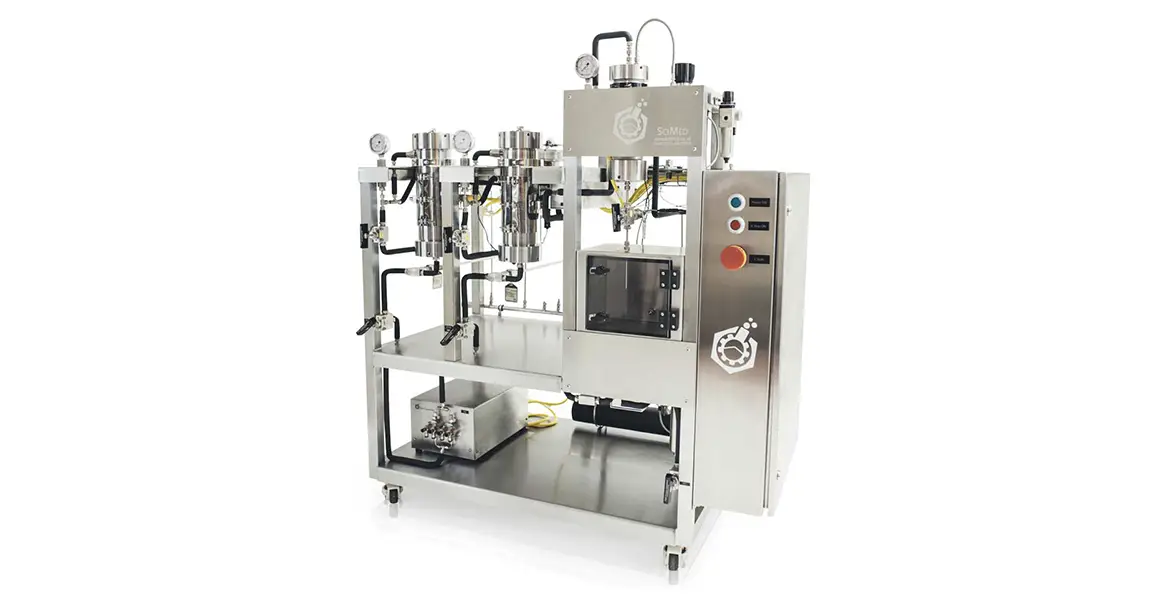
Specification
Pressure
Nominal operating pressure: 0 to 700 bar
Extended pressure capability: Up to 1100 bar
Pressure capability varies with system volume and temperature.
Temperature
Maximum allowable temperature: 200 °C
Note: Maximum temperature rating is not achievable at all pressure and volume combinations.
Volume
Minimum working volume: > 100 mL
Maximum working volume: Up to 10 L
Intermediate configurations (e.g., 1 L, 2 L, 5 L) may have different allowable pressure and temperature limits.
Key System Features
Software-Controlled Depressurisation (SFX)
- Integrated SFX depressurisation management enables controlled, programmable pressure release.
- Ideal for protecting delicate or pressure-sensitive structures, preventing damage from rapid decompression.
- Supports adjustable ramp rates and multi-step depressurisation profiles.
- Enhances repeatability and safety across all system configurations.
Adaptive Pressure Control (APC)
- Utilises SFX Adaptive Pressure Control (APC) for precise, real-time pressure regulation across the full operating envelope.
- Maintains stable pressure even under dynamic process conditions, fluid property changes, or thermal shifts.
- Optimised for high-pressure environments, ensuring smooth transitions between setpoints.
- Reduces overshoot, pressure oscillation, and operator intervention.
Precision Temperature Control
- High-accuracy temperature management for consistent thermal conditions up to system-rated limits.
- Intelligent integration with APC to coordinate heating/cooling with pressure changes.
- Suitable for sensitive materials requiring stable thermodynamic environments.
Tool-Less Access and User-Centric Design
- Tool-less entry system allows fast, convenient loading and unloading of vessels or sample holders.
- Minimises setup time, improves ergonomics, and reduces risk of incorrect assembly.
- Designed for routine laboratory use and rapid workflow cycles.
Integrated Safety and Automation
- System-level monitoring automatically enforces safe operation within the approved pressure–temperature–volume envelope.
- Built-in software safeguards prevent accidental operation outside rated limits.
- Adjustable alarms, interlocks, and automated shutdown sequences support continuous safe operation.